Triangle Windows in Aluminum Clad Wood
Gable ends, apex openings and sloped walls, made to your rough opening, not pulled from a shelf.

Triangle Windows: Custom Gable and Shaped Units for North American Homes
A triangle window is what you order when the wall stops being a rectangle. Under a pitched roof, the gable end gives you a shape with a wide base and two sloped legs, and a rectangular unit leaves daylight on the table. We build triangle windows on the same aluminum clad wood platform as the rest of this site: solid wood on the inside face, aluminum cladding outside, 6063-T5 profile, casement wall thickness about 2.0 mm. Right triangles, isosceles triangles, irregular three sided shapes and gable or apex windows all come off the same line.
Most triangle windows end up above a door or above a bank of rectangular windows, filling the wedge of wall the rectangles cannot reach. That location matters more than the frame color, because a high apex is hard to reach and hard to clean. It is also why so many of these units ship fixed. If you want one that opens, the shape has to leave enough straight frame at the corners for hinges and locking hardware. Steep, narrow triangles usually do not.
Nothing here is stock. Every triangle window is made to your rough opening, and the finished unit comes in so it seats with room for shims and sealant. Send a drawing or a set of field measurements and the technical team works back from there. Minimum order is 2 square meters, so a single gable unit and a full house package both fit the same process.
Fixed or Opening, and What the Shape Allows
Two decisions drive everything else on a triangle window: whether it vents, and how the corners get built.
Fixed Gable Units
The standard answer for gable ends and high apex locations. No hinges, no sash weight, no hardware fighting an acute corner. Fewer parts also means fewer places for air and water to find a way in.
Opening Triangles
Operating versions run on casement and awning hardware from ROTO, SIEGENIA and CMECH, with a multi-point locking system. The practical limit is the corner angle: a very sharp point leaves too little frame for hinges and locks, so steep triangles stay fixed.
Wood Inside, Aluminum Out
Interior faces come in Burmese teak, black walnut, cherry, red rosewood or American oak, with the aluminum cladding protecting the wood core from rain, sun and freeze thaw cycles. The exterior takes powder coating, anodizing or wood grain finishes.
Glass and Glazing
Double or triple Low-E insulating glass, with a 33 mm glazing notch and a built-in grille or lattice if you want the shape divided. Triple pane suits cold climates and noisy streets; a fixed triangle is the easiest place on the elevation to justify the upgrade.
Triangle Window Specifications
Values below describe the aluminum clad wood platform these shaped units are built on.
| Profile | 6063-T5 aluminum clad wood |
|---|---|
| Casement wall thickness | about 2.0 mm |
| Glazing notch | 33 mm |
| Glass | double or triple Low-E insulating glass |
| Interior wood species | Burmese teak, black walnut, cherry, red rosewood, American oak |
| Operating hardware | ROTO, SIEGENIA, CMECH |
| Locking | multi-point locking system |
| Exterior finish | powder coating, anodizing, wood grain |
| Minimum order | 2 square meters |
Options depend on the configuration you choose, and the opening angle of the triangle affects which hardware and glass build can be used.
Other Aluminum Clad Wood Windows
Triangle units rarely travel alone. These are the shapes they usually sit above or beside.
Wood Clad Windows
The full aluminum clad wood range, wood clad windows and clad windows explained in one place.
View details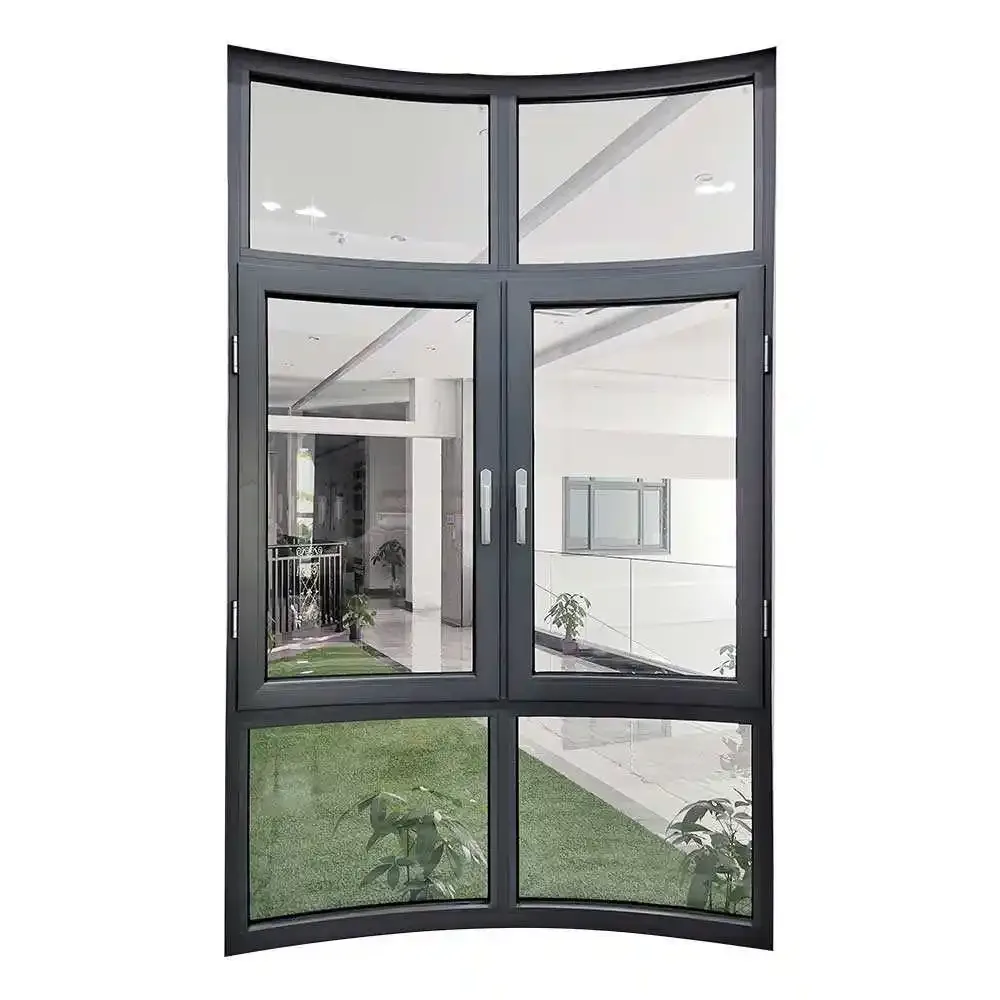
Aluminum Clad Wood Casement Windows
Aluminum clad wood casement windows, the same hardware family used on operating triangle units.
View details
Aluminum Clad Wood Single Hung Windows
Aluminum clad wood single hung windows with tilt-in sashes and American Caldwell handles.
View details
Aluminum Clad Wood Sliding Windows
Aluminum clad wood sliding windows for wide openings where a swing sash will not fit.
View detailsSizes, Angles and Mulling a Triangle Into a Window Wall
A triangle opening is defined by three measurements, not two. You need the base width, the height at the apex, and the length of each sloped leg. Measure each one at three points and take the smallest number, because rough openings are never as square as the drawing says. Send those figures plus the angle at each corner, and the finished unit comes back. A buyer who measures the drywall return instead of the framing will get a unit that does not fit, so measure the frame.
Combining a triangle with the rectangles below it is the usual build. The units are mulled together with mullion material so the gable reads as one window wall, and the joints line up with the verticals of the windows underneath. That takes a shop drawing, not a catalog order. Full customization and drawing-based customization are both available, and the minimum order is 2 square meters. If the triangle sits over a door, keep the base wide enough that the sloped legs do not crowd the head of the door frame.

Questions buyers ask
What is a triangle window called?
In the trade you'll hear gable window, apex window, geometric window or special shape window. Suppliers listing triangle shaped windows usually mean the same thing. The name changes with position: a unit under a pitched roof is a triangle gable window, one sitting over a door is often just called a transom or shaped transom. When you ask for a quote, describe the shape and the location, not the label.
How expensive are triangle windows?
Cost tracks the perimeter and the number of corners more than the square footage, because every mitre and every glazed corner is hand work. A wide, low triangle with two clean corners is cheaper than a tall, narrow one. Glass choice, wood species and whether the unit opens all move the number. Ask any supplier to price the perimeter, the corner count and the hardware separately so you can compare like for like.
Who makes triangle windows?
Custom window shops and factories that build to a rough opening, not big box retailers selling stock sizes. WANJIA Hiseng builds them in Foshan on the same aluminum clad wood line as our rectangular windows. When you're comparing suppliers, ask for the profile section drawing, the hardware brand, and whether they will work from your opening dimensions or only from their own size list.
What is a 90 degree triangle window?
A right triangle, with one square corner and two acute ones. It fits where a sloped ceiling or roofline meets a vertical wall, so you'll see it in stairwells, under mono pitch roofs and beside a chimney chase. The square corner is the easy one to build and glaze. The two sharp points are where the frame gets tight, which is why a 90 degree triangle is almost always a fixed unit.
Send Your Opening, Get a Quote
Send the drawing or the three opening measurements and we'll come back with a price.