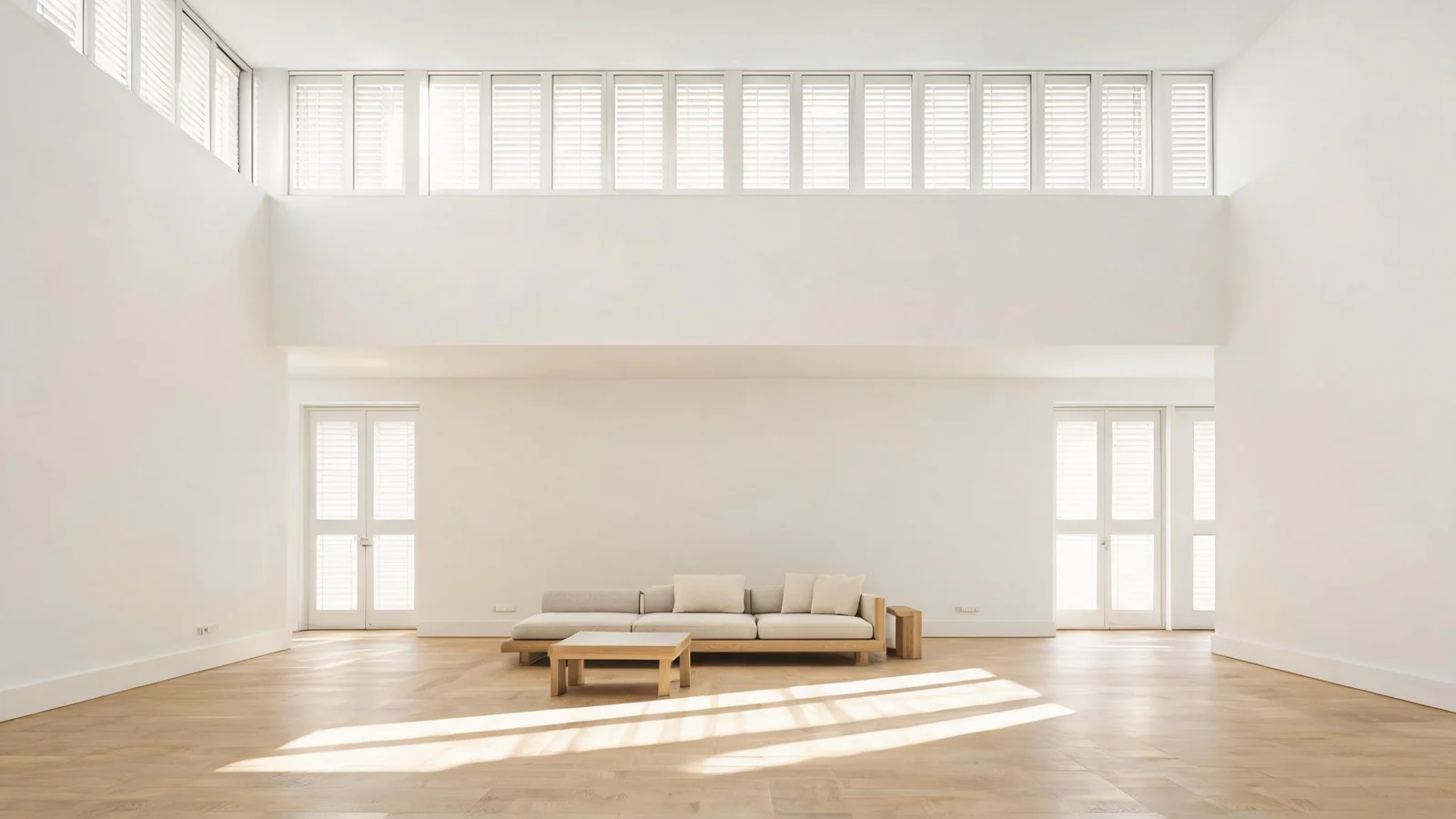
Clerestory windows sit high on a wall, above eye level. Light pushes deeper into the room. The wall below stays open for furniture, cabinets, art. Builders put them in rooms that would otherwise feel dark or closed off. Architects do the same.
How do they differ from other window types? Where do they earn their keep in a house or commercial job?
What a Clerestory Window Is
A clerestory window sits high on a wall, above your sight line. The name comes from "clear story," a building level that rises above the roofs beside it. In modern houses, these are often fixed or operable units installed between 6 and 8 feet from the floor.
Their main job is daylighting. Being high, they bring in sunlight without glare at eye level. They also give you privacy. No one outside can see in through a window above head height.
You can pair clerestory windows with other window types. A wall might have a row of casement windows down low and clerestory windows above. That combination gives you ventilation at the bottom and light up high.
How Clerestory Windows Work
Clerestory windows grab light from up high. With a standard 8-foot ceiling, one near the ceiling line bounces daylight off the ceiling and upper walls. That spreads light more evenly than a low window, which tends to create bright spots and dark corners.
On a south-facing wall, clerestory windows can bring in useful solar heat during winter. In summer, the high sun angle means less direct heat enters, especially with a small overhang or shading by the roof eave. Operable clerestory windows also support natural ventilation. Warm air rises. So opening a high window lets hot air escape. Pair it with a lower window or door and you get a stack effect that pulls cooler air through the space.
What makes it fixed
Most clerestory windows don't open. They're fixed, put high for light and a view, not air. You don't always need ventilation up there, and reaching them to open anything is a hassle, so most stay shut.
But not every fixed window is a clerestory. A fixed unit can sit at eye level and still be just a window. Clerestory means high placement, not non-opening. If you want air from up high, get an operable unit, like an awning window hinged at the top. Crank it open or use a pole, even when it's out of reach. That handles the height problem.
Clerestory or French?
French windows are tall, often floor-to-ceiling, and they open like doors. You see them in traditional and European-style homes. Unlike clerestory windows, French windows sit at eye level. You walk through them or look out. That is the point of them.
French windows bring in light and connect indoors to outdoors. A clerestory brings in light without using wall space or creating a view. Different purposes. But they work together. Put French windows on one wall and clerestory windows on another, and you get a strong visual connection plus balanced daylight without the brightness in your face.
Know the difference between a French window and a fixed window. A fixed window never opens. French windows typically have one or two sashes that swing inward or outward. Clerestory windows can be fixed or operable, depending on the design. So do not assume one is just a tall version of the other.
Gable and Triangle Windows
Gable windows live in the triangle at the top of a wall, under the roof peak. They follow the gable shape usually. Triangle, half-circle, whatever fits. A triangle window is just a gable window that happens to be a triangle.
Placement is not the same thing. A gable window sits in the gable end, but a clerestory runs along a wall below the roofline. Both get light into upper areas, so it comes down to where the wall space is and what you want lit.
And sometimes a row of clerestories works with a gable window to light a vaulted ceiling or a loft. Match the window style to the wall shape and the light you need. That is the job.
Where They Work Best
Living rooms and great rooms with tall ceilings are a natural fit. Clerestories add light without competing with artwork or furniture, so lamps stay off during the day. Kitchens, bathrooms, hallways, stairwells, offices, retail stores, warehouses - clerestories turn up in all of them.
Kitchens
Upper cabinets kill any chance for a low window. A clerestory above the cabinets gets light onto the counter and the ceiling, and the kitchen reads brighter and larger without losing wall space.
Bathrooms
Privacy is the whole game here. A clerestory lets daylight in while blocking any view from outside. Mount it high on an exterior wall or over a shower and you fix the privacy problem and still get natural light.
Hallways and Stairwells
Narrow spaces are almost always windowless. Put one at the top of a stairwell or along a hallway wall, and the space feels open and safe. You avoid that dead feeling of a dark corridor.
Commercial Spaces
Offices, retail stores, and warehouses use clerestories to cut artificial lighting costs. In a warehouse, a row along the upper wall lights a large floor area without glare on work surfaces. That is exactly why they show up in so many industrial buildings.
Materials and Construction
WANJIA Hiseng makes aluminum clad wood windows that work well up high. Aluminum outside, wood inside. The aluminum resists weather and needs almost no upkeep. The wood gives warmth.
The frame has to hold glass at a high position, so it needs real strength. Aluminum clad wood frames have that. The aluminum keeps rain and sun off the wood. Hard to reach windows don't get repainted often. That matters a lot when you're up on a ladder once a decade.
Glass can be double or triple pane with Low-E coatings. They cut heat gain and improve insulation. High windows take direct sun. That's not a small thing. You can add a built-in grille or lattice for an older look.
If the clerestory opens, hardware can be German brands like ROTO, SIEGENIA, or CMECH. They operate smoothly and lock reliably. Fixed clerestory windows skip the hardware entirely. That simplifies the design.
How WANJIA Hiseng sells clerestory windows
The factory is 219,325 square feet.We ship aluminum clad wood windows to builders, dealers, and architects in North America, and we build for export. That covers the operation.
Lead time runs 25 to 30 business days, depending on design and order volume. Send project details and get a quote within 3 hours. We help you pick window size, glass type, and frame finish.
Installation videos and guidance come after delivery. Remote assistance stays available until the job is done. Warranty terms vary by product and contract. For specifics, visit the contact page or look at our wood clad windows.
| Window Type | Placement | Operable? | Main Purpose |
|---|---|---|---|
| Clerestory | High on wall, above eye level | Often fixed, can be operable | Daylighting, privacy, ventilation |
| Fixed | Any height | No | Light and views |
| French | Floor to ceiling, often as doors | Yes, swings open | Access, light, connection |
| Gable | In gable end, under roof peak | Usually fixed | Light, architectural accent |
| Triangle | Matches gable shape | Usually fixed | Light, design feature |